
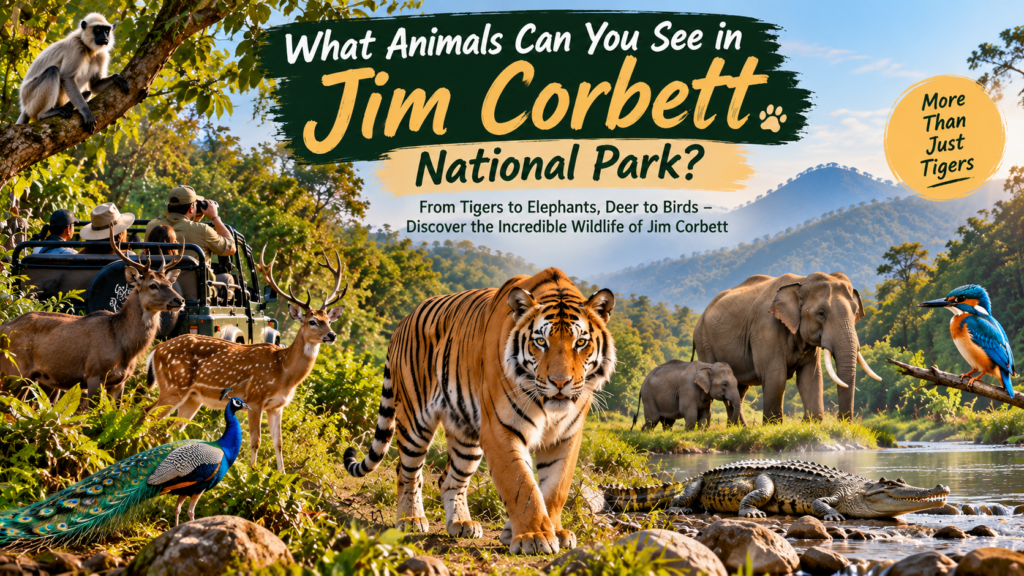
Most people enter Jim Corbett with one animal on their mind.
The tiger.
You can be driving through a beautiful Sal forest, an elephant can appear in the distance, spotted deer may be standing beside the track and dozens of birds can be calling from the trees…
…and somebody in the Jeep will still whisper:
“Tiger kahan hai?”
We understand.
Seeing a Bengal tiger in the wild is an incredible experience. But if you visit Jim Corbett National Park thinking the tiger is the only animal worth seeing, you’ll miss most of what makes this forest special.
Corbett Tiger Reserve is home to an impressive variety of wildlife. According to the Corbett Tiger Reserve administration, the reserve supports around 50 mammal species, 580 bird species and 25 reptile species.
So what might actually appear during your safari?
Let’s meet some of the residents.
1. Bengal Tiger – The Animal Everyone Is Looking For
Obviously, we have to start here.
The Royal Bengal tiger is the animal most closely associated with Jim Corbett.
A tiger sighting can happen surprisingly quickly, or you can spend the entire safari following alarm calls and pugmarks without seeing one at all.
That’s wildlife.
Tigers are solitary animals and can move through large territories. They aren’t sitting beside the safari track waiting for the morning Jeeps to arrive.
Sometimes a tiger walks openly along the track.
Sometimes you catch only a glimpse as it crosses through the forest.
Sometimes your guide points toward dense bushes and says there is probably a tiger inside.
You stare at the bushes for ten minutes.
The bushes continue being bushes.
Even without a sighting, knowing you’re travelling through genuine tiger habitat changes the entire safari experience.
And if one does walk out?
You’ll understand immediately why people return to Corbett again and again.
2. Asian Elephant – Hard to Miss, Impossible to Forget
For many visitors, elephants provide some of the most memorable moments of a Jim Corbett safari.
Corbett’s forests form important habitat for Asian elephants, and they may be encountered individually or in groups.
Seeing an elephant in a zoo and seeing one emerge naturally from a forest are completely different experiences.
A large tusker standing beside the forest track can make even the most talkative Jeep suddenly become very quiet.
Families with calves are particularly fascinating to watch from an appropriate distance.
And while everyone is looking for a tiger, an elephant occasionally appears as if to say:
“Excuse me, I’m also quite impressive.”
It has a point.
3. Chital – The Spotted Deer You’ll Probably Meet
The beautiful chital, or spotted deer, is one of the animals visitors commonly associate with Indian forests.
They are elegant, alert and extremely photogenic.
After seeing your first few, you’ll probably stop the Jeep and take twenty photographs.
Later in the safari:
“Oh, another deer.”
Don’t become too casual about them.
Chital play an important role in the forest ecosystem and can also help alert other animals—and safari visitors—to the possible presence of predators.
Their alarm calls can suddenly change the mood of a safari.
One minute you’re casually watching deer.
The next minute the guide raises a hand and everyone becomes silent.
Something may be moving nearby.
Suddenly those “ordinary deer” become very interesting indeed.
4. Sambar Deer – Bigger, Darker and Worth Watching
The sambar is considerably larger than the chital and has a darker, heavier appearance.
They’re another important prey species for large predators such as tigers.
A sambar’s alarm call is something many wildlife enthusiasts listen for during a safari.
If an experienced guide suddenly becomes interested in a sambar staring intensely toward the forest, pay attention.
The deer may know something you don’t.
Of course, sometimes nothing appears.
That’s another recurring theme in wildlife tourism.
The animals have considerably more information than the tourists.
5. Leopard – The One That Doesn’t Like Making Things Easy
Corbett isn’t only tiger country.
Leopards also occur within the reserve.
Seeing one, however, can be considerably more difficult.
Leopards are secretive, beautifully camouflaged and remarkably good at disappearing into vegetation.
A leopard can be much closer than you realise without being visible.
That makes a sighting particularly rewarding.
People sometimes assume that because Corbett has tigers, leopards must be standing conveniently somewhere nearby as well.
Nature doesn’t work like a supermarket wildlife aisle.
Different predators use habitats and territories in different ways.
If you’re fortunate enough to spot a leopard during your Corbett safari, enjoy the moment.
6. Sloth Bear – A Less Expected Corbett Resident
This one surprises some first-time visitors.
Sloth bears occur in parts of the Corbett landscape, including areas such as Dhela, where the official Corbett Tiger Reserve information specifically mentions their presence.
They are generally less commonly encountered by ordinary safari visitors than deer or elephants.
That makes a sighting particularly interesting.
With their shaggy dark coat and distinctive appearance, they’re difficult to confuse with anything else once you get a proper look.
Unless the sighting lasts three seconds.
Then everyone in the Jeep will spend the next ten minutes debating what they actually saw.
7. Wild Boar – Not Glamorous, Still Important
Wild boar don’t usually appear on someone’s wildlife bucket list.
Nobody travels 250 kilometres saying:
“I really hope we see a wild boar.”
But they are part of the forest ecosystem and can be surprisingly entertaining to watch.
They may be seen moving through grassland or forest areas, often searching for food.
Young piglets are particularly distinctive.
They also form part of the prey base supporting larger predators.
Not every animal needs celebrity status to be important.
8. Jackal – The Forest’s Opportunist
The golden jackal is another animal officially highlighted among the wildlife found in Corbett.
Jackals are adaptable animals and may sometimes be spotted moving through open areas.
They’re smaller than many first-time visitors expect.
Because the tiger receives most of the attention, smaller carnivores are sometimes overlooked.
But spotting a jackal gives you another glimpse into how many different predators and scavengers share this ecosystem.
9. Barking Deer – Yes, It Really Sounds Like That
The barking deer, also known as muntjac, gets its popular name from its distinctive alarm call.
And yes, it can genuinely sound surprisingly dog-like.
The first time you hear one in a forest, you may wonder:
“Who brought a dog into the jungle?”
Nobody did.
The deer is doing it.
These alarm calls can be particularly interesting because prey animals may call when they detect predators nearby.
For safari guides, listening can sometimes be as important as looking.
10. Gharial and Mugger Crocodile
Corbett isn’t only forest and grassland.
The Ramganga River and associated aquatic habitats add another dimension to its wildlife.
Visitors may encounter crocodilians, including gharials and mugger crocodiles in suitable areas.
Gharials are especially distinctive because of their long, narrow snouts.
Unlike the tiger, which everybody is desperately searching for, a crocodile may be sitting completely still in full view.
The challenge is noticing that what you thought was a log has teeth.
River areas can therefore be particularly rewarding for wildlife observation.
11. Langurs and Monkeys
You won’t have to conduct an elaborate tracking operation to find monkeys around many parts of Uttarakhand.
Hanuman langurs are among the primates associated with the Corbett landscape.
They can often be fascinating to watch.
Langurs also contribute to the forest’s natural alarm system. Their calls and behaviour can sometimes indicate that a predator is moving nearby.
An experienced guide may suddenly stop paying attention to the road and start listening to monkeys in the trees.
That’s when you should probably stop discussing breakfast and start looking around.
12. King Cobra and Other Reptiles
Corbett is also home to reptiles.
The official information for Dhela Zone, for example, specifically mentions the presence of king cobras, while the reserve overall reports around 25 reptile species.
Snakes aren’t usually the stars of a Jeep safari, and many visitors won’t see one.
But they are an important part of Corbett’s biodiversity.
Other reptiles, including monitor lizards and various snake species, may also occur across the wider landscape.
The correct approach is simple:
Observe wildlife from a safe distance and let it continue with its day.
The snake has absolutely no interest in appearing in your selfie.
13. Birds – The Wildlife Most Visitors Underestimate
Here’s where Corbett becomes much bigger than a tiger safari.
The reserve reports approximately 580 bird species.
That makes the landscape extremely rewarding for birdwatchers.
Kingfishers are among the birds highlighted by the official reserve website, along with the beautiful Asian paradise flycatcher.
Depending on habitat and season, visitors may encounter woodpeckers, eagles, vultures, parakeets, hornbills, waterbirds and many other species.
You don’t need to arrive as a serious birdwatcher to enjoy them.
In fact, plenty of people enter Corbett saying:
“I don’t really know anything about birds.”
Three hours later they’re asking the guide:
“What was that blue one?”
Congratulations.
That’s how it starts.
What Animals Are You Most Likely to See?
This is difficult to answer precisely because wildlife sightings change with season, habitat, zone, weather, time of day and plain luck.
Animals such as chital, sambar, langurs and various birds may be encountered more readily than elusive predators.
Elephant sightings can also be memorable in suitable areas.
Tigers and leopards are different.
Their presence in the forest does not mean you’ll necessarily see them during a particular safari.
A tiger may be only a short distance from the track and remain completely invisible.
That’s why wildlife sightings should never be guaranteed.
Which Jim Corbett Zone Has the Most Animals?
There isn’t one zone where somebody has conveniently placed all the animals.
Different Corbett tourism zones contain different combinations of forest, grassland, riverine habitat and terrain.
For example, the official Corbett information for Dhela mentions tigers, leopards, Asiatic elephants, sloth bears, king cobras and rich birdlife.
Garjia is described as supporting wildlife including elephants, tigers, sambar, leopards, reptiles and numerous bird species.
But that doesn’t mean booking one of those zones guarantees those sightings.
Wild animals move.
That’s rather important to the whole concept of being wild.
What Is the Best Animal to See in Jim Corbett?
There isn’t one correct answer.
For many people, it’s obviously the tiger.
For someone else, watching a herd of elephants cross through the forest may become the highlight of the entire holiday.
Birdwatchers can spend hours ignoring the animal everyone else is searching for because they’ve spotted something interesting in a tree.
Children sometimes become more excited about monkeys than tigers.
And occasionally the most memorable moment isn’t a clear sighting at all.
It’s hearing an alarm call.
Finding fresh pugmarks.
Watching every deer suddenly look in the same direction.
Or sitting silently while your guide listens for movement somewhere inside the forest.
That’s what makes a safari different from visiting a zoo.
Don’t Judge Your Safari Only by Whether You Saw a Tiger
This is probably the most important part.
A tiger sighting is special.
But:
No tiger ≠ bad safari.
Corbett is an ecosystem, not a tiger exhibition.
There are elephants moving through the landscape, deer watching from the grass, crocodiles beside rivers, monkeys calling from trees, birds overhead and predators that may remain completely hidden.
If you spend the entire safari asking:
“Tiger kab dikhega?”
you may miss half the forest while waiting for one animal.
Planning a Jim Corbett Safari
If wildlife viewing is the main reason for your Corbett trip, plan your safari before finalising everything else.
Safari zones, shifts and permits are subject to availability and applicable Corbett Tiger Reserve rules.
Travellers who would like assistance understanding the available options can use our Jim Corbett Safari Booking service.
JimCorbetts.in can also assist with accommodation and transportation when planning the wider trip.
JimCorbetts.in is an independent private travel agency and is not the official website of Corbett Tiger Reserve, Uttarakhand Forest Department or any government authority. Wildlife sightings, including tiger sightings, are completely natural and cannot be guaranteed. Safari permits and forest entry remain subject to applicable official rules and availability.
Go Looking for Wildlife, Not Just a Tiger
Of course, keep your eyes open for the tiger.
Everybody does.
But also watch the elephants.
Listen when the deer start calling.
Look toward the river for crocodiles.
Ask your guide about the birds.
Notice the monkeys suddenly becoming alert.
Sometimes the forest gives you exactly the sighting you hoped for.
Sometimes it gives you something completely different.
You may enter Jim Corbett hoping to photograph a tiger and return home talking about an elephant that crossed the track ten metres ahead of your Jeep.
That’s the nice thing about wildlife.
You choose the safari. The forest chooses what you see.